
Ranking first on Google is worth less every quarter: the 2026 data
 By Jero Shannon Published
The top Google result gets 58% fewer clicks when an AI answer appears, and ChatGPT now has 900 million weekly users. The data, what it means for a Mallorca business and where to start.
For years, every website had the same goal: rank first on Google. It still matters, but in 2026 that top spot brings noticeably fewer visits than it used to. The reason is simple: more and more searches are answered without the person ever opening a website, and more and more people ask an AI directly. Here are the numbers and what they mean for a business.
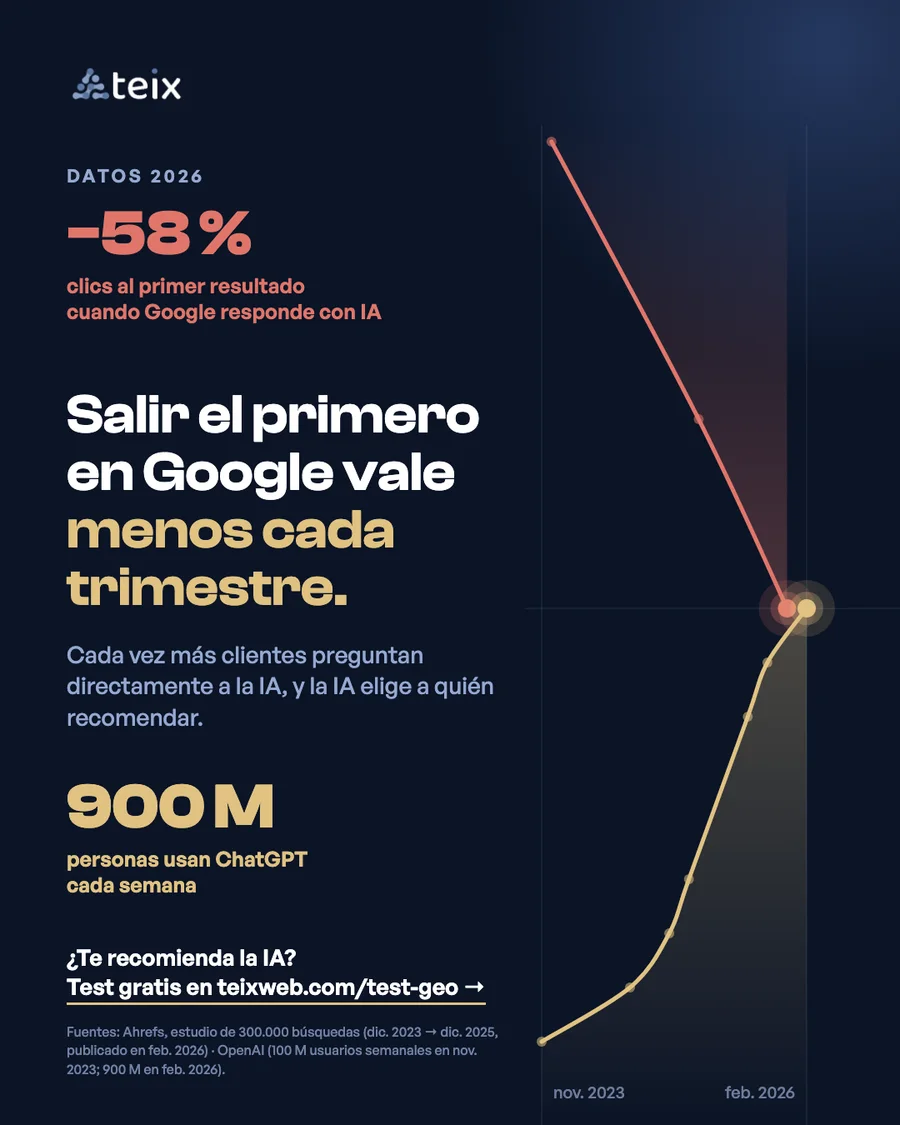
The three figures that explain it
1. The top result loses 58% of its clicks when Google answers with AI. Ahrefs analysed 300,000 searches, comparing December 2023 with December 2025, and published the results in February 2026. When Google's AI answer (AI Overviews) appears, the site ranking first gets 58% fewer clicks. In April 2025, the same study put it at 34.5%: the drop has almost doubled in under a year. The second result loses around half.
2. Almost 7 in 10 searches end without a click. According to SparkToro, using Similarweb data, 68% of Google searches in the United States between January and April 2026 ended without the person visiting any website. They read the answer on Google and carry on with their day.
3. ChatGPT has 900 million weekly users. That is the figure OpenAI gave in February 2026; in November 2023 it was 100 million. Add Gemini, Perplexity, Copilot and Google's own AI mode on top.
It is worth being honest about the other side: the traffic that reaches websites from AI tools is still small, and Google remains the main source of customers for almost every business. But the direction is clear, and people who arrive at your site after an AI has recommended you usually arrive with the decision largely made.
What this means for a business in Mallorca
Picture someone who has just arrived in Palma and asks ChatGPT "recommend a physiotherapist in Palma who speaks English", or a tourist asking "where to eat fresh fish in Port de Sóller". They don't get ten links: they get two or three names with an explanation. If your business isn't there, that person never gets to see you, even if your website ranks first on Google for that same search.
The competition is no longer for ten slots on a page, but for two or three mentions inside an answer. And those mentions can't be bought: they are earned through what the AI has been able to read about you, on your website and beyond it. We call this GEO, and we explain it in detail in GEO: how to rank your website in AI search engines.
Where to start this week
See where you stand. Ask ChatGPT, Gemini and Perplexity the questions a customer would ask you, and note whether you appear, what they say about you and who they name instead. If you would rather do it in two minutes and in an orderly way, use our free AI visibility test.
Make your website say things clearly, and up front. Who you are, what you do, in which area and for whom, in text and in the first lines of every page. AIs read fragments: what sits inside an image or is buried at the bottom is not used.
Put your house in order beyond your website. A complete, up-to-date Google listing, reviews, directories in your sector and mentions in other media. The AI cross-checks these sources to decide whether it can trust you. We go into detail in how to get ChatGPT to recommend your business.
Look after the technical foundations. Structured data, a fast website that can be read without relying on JavaScript, and not accidentally blocking AI crawlers. It is all covered in structured data, llms.txt and E‑E‑A‑T.
Measure this too. Keep watching your Google rankings, but repeat the test in the AIs every month. Answers change, and what doesn't show up today may show up tomorrow.
SEO isn't disappearing: the goal is changing
None of this means giving up on SEO. A good part of what AIs read reaches them through search engines, and a well-ranked website has far better odds of ending up cited. What changes is the target: it used to be ranking first; now it is being the business the AI chooses to answer with.
Most businesses in the islands aren't thinking about this yet, and that is an opportunity. If you would like us to look together at how AIs see you today, find out how we work on it in our AI search optimisation service. Get in touch and we'll take a look.
Sources: Ahrefs: AI Overviews reduce clicks by 58% (February 2026) · Search Engine Land: 68% of Google searches end without a click (2026) · OpenAI: 900 million weekly ChatGPT users (February 2026).
Keep reading
Related articles