Structured data, llms.txt and E‑E‑A‑T: the technical base for AI to cite your site
 By Jero Shannon Published Updated
For an AI to understand and cite you, your site has to speak its language. We go over the technical layer of GEO without unnecessary jargon: schema, llms.txt, bot access and trust signals.
Good content is half of GEO. The other half is technical: making it easy for the machine to understand who you are and what you say. If you're not yet sure what GEO actually is, start with what GEO is and how to rank your website in AI search engines; here we focus on the layer nobody sees. You don't need to be an engineer to know what to ask whoever runs your website for, and that's exactly what you'll find below: what each piece is, what it's for and what to ask.
Structured data: telling the machine what each thing is
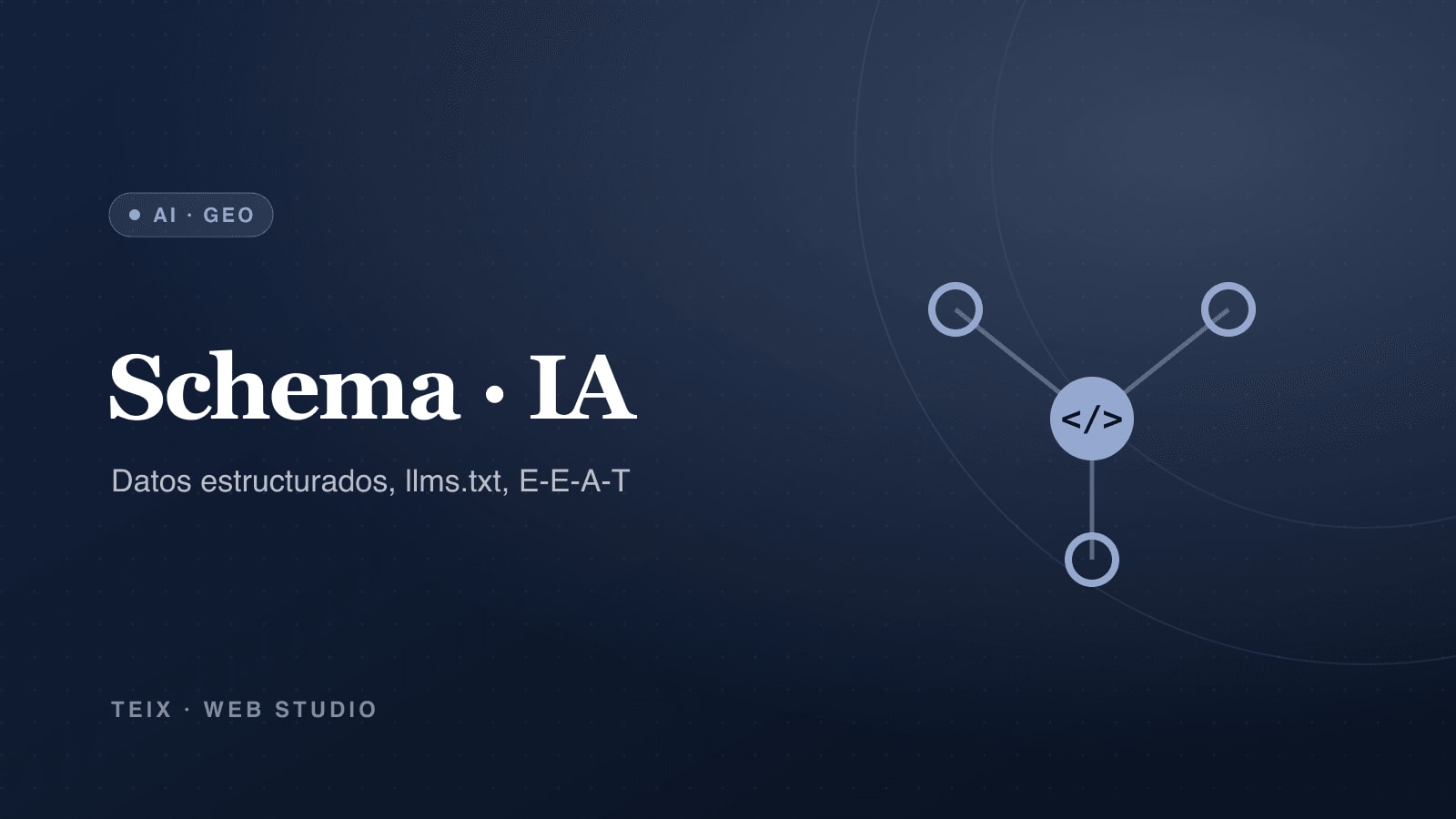
Structured data (schema.org) is code invisible to the visitor that tells Google and AIs, unambiguously, what each thing is: “this is a local business”, “this is an article written by X”, “this is a frequently asked question with its answer”, “this is a 5‑star review”. A person picks up the context at a glance; a machine doesn't always. Marking up your site well with schema is one of the things that helps most to get cited correctly, with your name, your address and your business described as they really are.
Which types matter to a Mallorca business? Almost always LocalBusiness or its specific variant (Restaurant, Dentist, Hotel, RealEstateAgent…), with name, address, phone, opening hours and service area; Organization with your logo and social profiles; Article with author and date on blog posts; FAQPage wherever there genuinely are frequently asked questions; and Product or Offer if you sell online. A hotel in Sóller and a building firm in Manacor don't need the same markup, but both need it to match exactly what's visible on the page. Marking up things that aren't visible, or inflating ratings, is the quickest way to get Google to ignore it.
You don't need to read code to check it: Google's Rich Results Test tells you what it has detected on any URL and whether there are errors. If it comes back empty for your home page, you know where to start.
AI crawler access: who you let in
Just as Google has its bot, OpenAI has GPTBot, Anthropic has ClaudeBot, Perplexity has PerplexityBot, and so on. If you want to appear in their answers, you usually want to let them read you. It's controlled from robots.txt, a text file at the root of your site that tells each bot what it may and may not crawl.
It's a strategic decision: let in whoever suits you. A publisher that lives off its content may prefer to block; a restaurant, a clinic or an estate agency that wants to be recommended almost always gains by being readable. The problem is that plenty of sites block without knowing it: an overzealous security plugin, a rule copied from another site, a hosting firewall that shuts out everything that isn't Google. It's worth opening your robots.txt (yourdomain.com/robots.txt) and asking whoever manages your server whether anything is blocked at hosting level.
llms.txt: a summary of your site written for AI
llms.txt is an emerging standard: a text file at the root of your site that summarises, in plain language, what you offer and which pages matter, designed specifically so language models understand you quickly. The format is simple: the business name, one or two sentences explaining what you do and where, and a list of links to the key pages with a one-line description each.
It's early days and not every AI reads it, so don't expect miracles. But implementing it is cheap, has no downside and puts you ahead of those who don't know it yet. It also has a useful side effect: being forced to write down in five lines what you do and which pages matter often reveals that your website doesn't make it as clear as you thought.
E‑E‑A‑T: the trust signals that aren't code
E‑E‑A‑T stands for experience, expertise, authoritativeness and trust. It's not code, it's signals. An author with a name and a track record, a real “about us” page, a physical address, reviews, case studies explained properly. AIs, like Google, prefer to cite those who prove they know what they're talking about and that they're a real business, not a ghost page.
In practice, for a local business it comes down to very concrete things: photos of the team and the premises instead of stock images, the name of whoever writes the articles, full contact details that match your Google Business Profile, a legal notice with the registered company name, and real projects described in detail. An accountancy practice in Palma that explains who runs it, since when and what kind of cases it handles conveys far more trust, to Google and to AI, than one with three generic paragraphs.
The usual foundations: speed, clean HTML and accessibility
On top of all this, the usual: a fast site, with clean semantic HTML, that loads well and is accessible. A machine reads a well‑built site better. That means properly nested headings, text that exists in the HTML rather than only inside images or slow-loading scripts, links whose text explains where they go, and images with alt text.
Speed matters twice over: bots spend a limited amount of time on each site, and so do visitors. If you want to see what that means in real customers, we cover it in why a slow website costs you customers.
Common mistakes we find when reviewing websites
Some faults come up again and again. The first is generic schema that a plugin generated years ago with details that are no longer right: the old phone number, the address from before the move. The second is blocking AI bots without ever having decided to. The third is multilingual sites where the markup only exists in Spanish, when a good share of customers ask in English or German. The fourth is important information hidden in PDFs, in tabs loaded by JavaScript or in images with text. And the fifth is not having a single page that says who is behind the business.
Where to start if your site has none of this
You don't need to do everything at once. A sensible order: first, check robots.txt to make sure you're not blocking anyone by mistake; next, mark up the business with LocalBusiness and the exact details; then strengthen the trust signals on your about and contact pages; and finally, add llms.txt and the markup for articles and FAQs. If you'd like to know how AI sees you today before touching anything, take the AI visibility test.
At Teix we build sites with this base already in place — schema, performance, trust signals — because that's what makes content work, today on Google and tomorrow in AI. If your site is already built and you want to bring it up to date, that's exactly what we do in technical SEO and AI search optimisation.
Sources: Google: introduction to structured data · Schema.org: the LocalBusiness type · Google: introduction to robots.txt · OpenAI: overview of OpenAI crawlers (GPTBot and OAI-SearchBot)
Keep reading
Related articles