Google AI Overviews: what they are and how to appear in AI answers
 By Jero Shannon Published Updated
Google now answers many searches with an AI‑generated summary, before the links. Here's how it works and what to do so your site is one of the sources it cites.
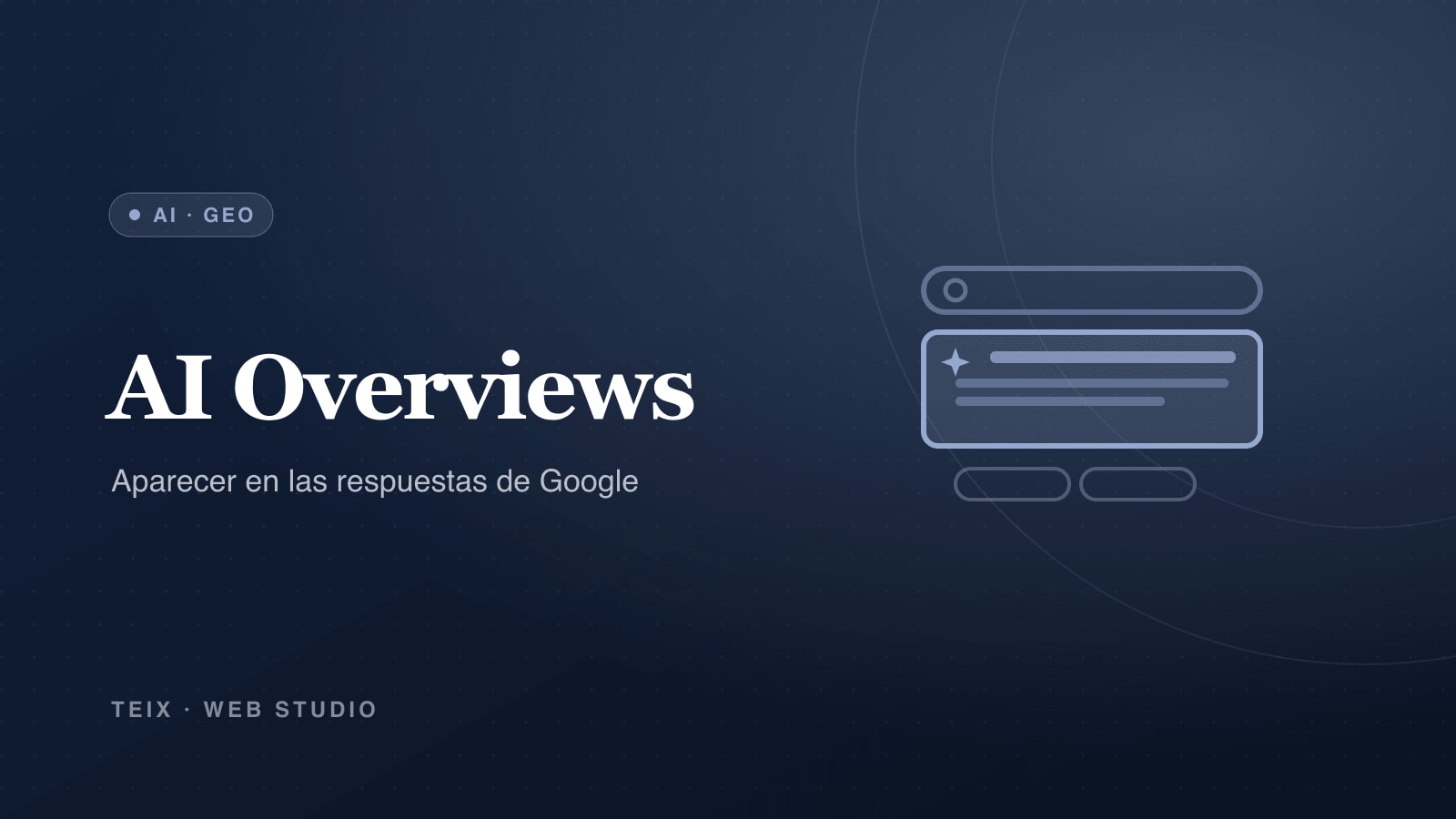
If lately you search on Google and, before the usual results, you see a box with a written answer and a couple of linked sources, those are AI Overviews: the AI summary Google places right at the top. For many informational searches it's already the first thing — and sometimes the only thing — the user reads.
What AI Overviews actually are
They run on a Gemini model adapted for search: Google interprets the question, consults its index, gathers several pages and writes a summary with links to the sources it has used. They don't appear on every search. They show up mainly for informational questions or ones with several nuances, and far less when someone searches for a specific brand or wants to reach a particular website. They also sit alongside AI Mode, a conversational way of searching within Google where the logic for choosing and citing sources is very similar.
What changes for your website: fewer clicks, but a better shop window
This has one uncomfortable consequence and one hopeful one. The uncomfortable: there are searches where the user keeps the summary and clicks on no one (the famous “zero‑click”). The hopeful: if your site is one of the sources Google cites in that box, you gain visibility and authority in the most visible spot on the page.
For a local business, the effect has nuances. Purely informational searches — “what paperwork do I need to rent my flat to tourists”, “how often should a pool be serviced” — are the most exposed to getting no click. Searches with the intent to hire or buy — “kitchen renovation quote Palma”, “physiotherapy clinic in Inca” — still lead to visits, because in the end the person wants to talk to someone. And anyone who sees your website cited in the summary and then clicks arrives with half the work done: they already know who you are and why you might be of interest.
How Google chooses the sources it cites
Which pages does Google pick for those summaries? It tends to draw on content it already considers useful and trustworthy, and that answers the question directly. So the first step is the same as ever: quality content that genuinely resolves the doubt. On top of that base, some tweaks help.
Before the tweaks, a requirement many people overlook: to be cited, a page has to be indexed and eligible to appear with a snippet in the normal results. There's no special markup and no application to get into AI Overviews. If Google can't crawl your site properly, or if a page loads so slowly or so badly that it isn't indexed with all its content, there's simply nothing to cite. That's why technical SEO is still the foundation: a slow website costs you customers and, along the way, chances of appearing in the summary too.
Structure your content as questions and answers
The most important tweak: structure your content in question‑answer format. Headings that are real questions (“How much does an online store cost?”) followed by a clear, concise answer in the first sentences. That makes it easy for the model to pull out a quotable snippet. FAQ sections work especially well, and their structured-data markup helps Google understand what each thing is, although on its own it doesn't guarantee an appearance.
An example. An estate agency in Palma whose website has a page titled “Services” has little chance of being cited. The same agency with a guide answering “What costs are involved in buying a house in Mallorca as a foreigner?”, with the answer summarised at the top and the detail afterwards, offers exactly the kind of snippet the summary needs. Short paragraphs also help, as do one idea per section, lists where there genuinely are steps, and a visible update date on topics that go out of date. Working every page this way is what we do in content SEO.
Show there's a trustworthy business behind it
Second: trust signals. Google is more likely to cite those who demonstrate experience and authority — an identifiable author, a real business with address and reviews, up‑to‑date content. It's no coincidence this overlaps with its famous E‑E‑A‑T; in AI answers it weighs even more.
In practice: sign articles with a real person and a short biography, display your address and contact details, show real projects or cases, link to your reviews and revise whatever has gone stale. A text discussing regulations from years ago or prices you no longer charge is exactly the kind Google prefers not to cite. And all of that, also declared in your website's structured data, is explained step by step in schema, llms.txt and E‑E‑A‑T to get cited by AI.
How to tell whether you appear, and what to measure
Google doesn't currently offer a separate report for AI Overviews: clicks and impressions from those links are counted within the normal performance report in Search Console. So checking has two parts. One is manual: search the key questions in your sector and note whether the summary appears, which sources it cites and whether you're among them. The other is about trends: in Search Console, look at informational pages whose impressions hold steady or rise while the click-through rate falls, because that usually means the answer is staying on the results page itself.
A question we're sometimes asked: “What if I don't want Google to use my content in the summary?” There are directives such as nosnippet to limit it, but they also remove your snippets from the normal results. For almost any local business it isn't worth it: being cited beats being invisible.
Common mistakes that leave you out
Writing for the algorithm rather than the person, stuffing in keywords. Hiding the answer at the end of a long text to “keep” the reader. Publishing generic content that could belong to any company in any city, with no first-hand experience at all. Leaving pages with out-of-date information. And thinking AI Overviews are a world apart from SEO, when they share the same foundations, as we explain in SEO vs GEO: what changes for your website.
No magic button, but a clear direction
There's no magic button to “appear in AI Overviews”, but there is a clear direction: answer better than anyone, make it easy for a machine to read, and prove there's a trustworthy business behind it. It's exactly what we work on in every website we build at Teix and in our AI search optimisation service. If you'd like to know where yours stands, request the free audit and we'll tell you what to fix first.
Sources: Google: AI features and your website (AI Overviews and AI Mode) · Google: creating helpful, reliable, people-first content · Google: robots meta tag specifications (nosnippet) · Search Console Help: the performance report
Keep reading
Related articles